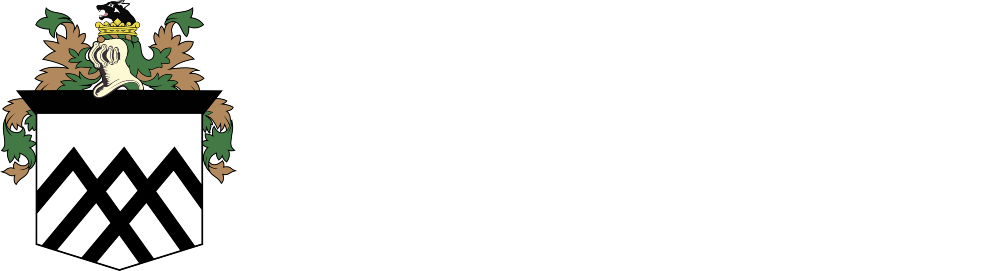
The coat of arms previously featured on the front page, pictured to the right, has been replaced by the more commonly accepted version on the left. The coat of arms on the right was the original coat of arms granted to the family of Cliburn, of the City of Cliburn in the County of Westmorland, in c. 1584-1585. This is the family from which our ancestor Joshua Clyburn descended.
The arms were argent, three chevronels interlaced in base and a chief sable. The crest features a demi wolf proper, rampant and regardant. Click here for descriptions and definitions of these heraldry terms.
According to the ancient English rules of heraldry, only one person could use the arms at a time, usually the father as the head of the family. Other members of the family would have to use slightly modified versions until the father died, at which point the original arms would be inherited. Typically the modifications would involve a slight color change or the addition of a new “charge” or field.
Over time, due to these modifications, a new “charge” of an “engrailed cross” was added to the Cliburn shield and eventually became the more commonly used version. The word engrailed is distantly related to grill, implying protection. The feature of the engrailed cross for Christians is its spikes, which represent the thorns piercing Jesus’ head during His crucifixion. The engrailed crosses in the newer version were drawn by Harriette Pinnell Threlkeld, one of the original researchers of Claybourn family history.
The motto in Saxon is “Lofe clibbor na sceame”, which means “Tenacious of what is right, not of what is shameful.” The motto in Latin is “Confide recti agens”, which means roughly the same thing.
As an aside, William Claiborne – the Secretary of Virginia born c. 1600 – used the Cliburn coat of arms on his official documents, and the Cliburn heraldic emblem is on numerous Claiborne family gravestones, especially in Virginia. Descendants of this William include fashion designer Liz Claiborne and William C.C. Claiborne, first governor of Louisiana, as well as a number of political figures from Tennessee and Virginia.
Given the similarities in name and coat of arms, it was long suspected that the Claybourn family was related to this William. But in the 1940s, a Virginia genealogical researcher dispelled Claiborne’s Westmorland lineage after determining that Claiborne was the son of Thomas Clebourne, a Kent, England, native who once served as mayor, alderman and justice of the peace in King’s Lynn, a Norfolk, England, village. More recent DNA studies have confirmed that William is not related to the Claybourns and did not descend from the Cliburn family of Westmorland. Thus, William’s use of the coat of arms is a mystery.
Nevertheless, descendants of the Claybourn family can rest assured that this coat of arms is their own.


and I just put the “crossless” version on my facebook page!
Seriously, I’ve always like MH’s version the best, anyway.
Awsome post and straight to the level. I really do not know if this really is basically the best put to ask but do you men have any ideea in which to hire some specialist writers? Thanks
These are typically good guidelines i always will ever try away, We’re pleased I came across the item. Appreciate it.
shrimp
We have turned up to the selection that your particular head line “
Thank you a bunch for sharing this with all folks you really recognize what you are speaking approximately! Bookmarked. Please additionally consult with my website =). We will have a hyperlink change arrangement between us!
payment processing Brick & Mortar…
[...]Claybourn Coat of Arms « Claybourn Genealogical Society News[...]…
While Dark Knight Rises , International Olympic Athlete Touches down ready for the Big Competition |
Woah this weblog is great i really like studying your posts. Keep up the great work! You know, a lot of people are hunting round for this information, you can help them greatly.